

If you’ve applied for a clinical trial, signed up for a long-term consumer panel, or received an invitation to a multi-session market research study, you may have run into the term “cohort” without a clear explanation of what it means. Understanding what is a cohort — and how cohort studies work — can help you decide which research opportunities are worth your time, what to expect as a participant, and how to plan around the compensation. The concept is simpler than it sounds, and once you understand it, you’ll start recognizing cohort-based research everywhere in the world of paid studies, clinical trials, and consumer market research.
What Is a Cohort? The Core Definition
At its most basic, a cohort is a group of people who share a defining characteristic and are studied or observed together over a period of time. The word comes from the Latin cohors, referring to a unit of Roman soldiers who trained and served together. That original meaning still captures the modern idea: a group of people bound by a shared experience, starting point, or trait, moving through time in parallel.
The term shows up across many fields with slightly different emphasis. In a university setting, your cohort is the group of students who enrolled in the same program at the same time as you. In public health and medicine, a cohort is a group who share a common exposure — a medication, a lifestyle factor, an environmental condition — and are tracked over time to observe outcomes. In market research, cohort analysis groups people by shared behavioral or demographic characteristics to see how attitudes and behaviors evolve. Dictionary definitions of the word reflect this range, spanning both the historical military origin and the modern scientific usage.
What ties these definitions together is a shared starting point plus the passage of time. A cohort isn’t a random sample — it’s a group defined by something in common, observed over time to see how that shared trait relates to later outcomes. That’s what separates a cohort study from a one-time survey or a cross-sectional study that only captures a single snapshot.
What Is a Cohort Study? Understanding the Research Design
A cohort study is a research design in which a defined group — the cohort — is followed over an extended period, with researchers collecting data at multiple points to see how variables change or outcomes develop. This longitudinal approach is used widely, from epidemiology and clinical medicine to consumer psychology and brand strategy. Compared to a one-time survey, a cohort study captures an entire arc of change across the same group of people rather than a single moment.
In a prospective cohort study, researchers identify participants at the start and follow them forward. For example, a pharmaceutical company might recruit a cohort with a specific health condition, give some participants a new medication while others receive a placebo, then monitor both groups for one to five years. From the participant’s side, this usually means periodic check-ins, surveys, medical appointments, or data submissions — typically with compensation at each stage. The National Institutes of Health provides detailed guidance on how cohort and other clinical research designs work and what participants can expect.
In a retrospective cohort study, researchers look backward, using historical data to define the cohort and trace outcomes that already happened. Participants may only provide records, interviews, or samples at a single point in time, but the analysis still treats them as part of a defined group. Retrospective designs are faster and cheaper to run but depend heavily on the quality of existing records.
Cohort studies differ from clinical trials in that they typically observe what happens naturally rather than randomly assigning treatments — though the line can blur in observational trials that monitor participants receiving a new drug under real-world conditions. This distinction matters to participants because it affects how much commitment is required and what compensation is realistic to expect. Applying to a study is never the same as being accepted, and payment is tied to actually completing the required visits or submissions, not just enrolling.
Cohort Market Research: What It Means for Consumer Participants
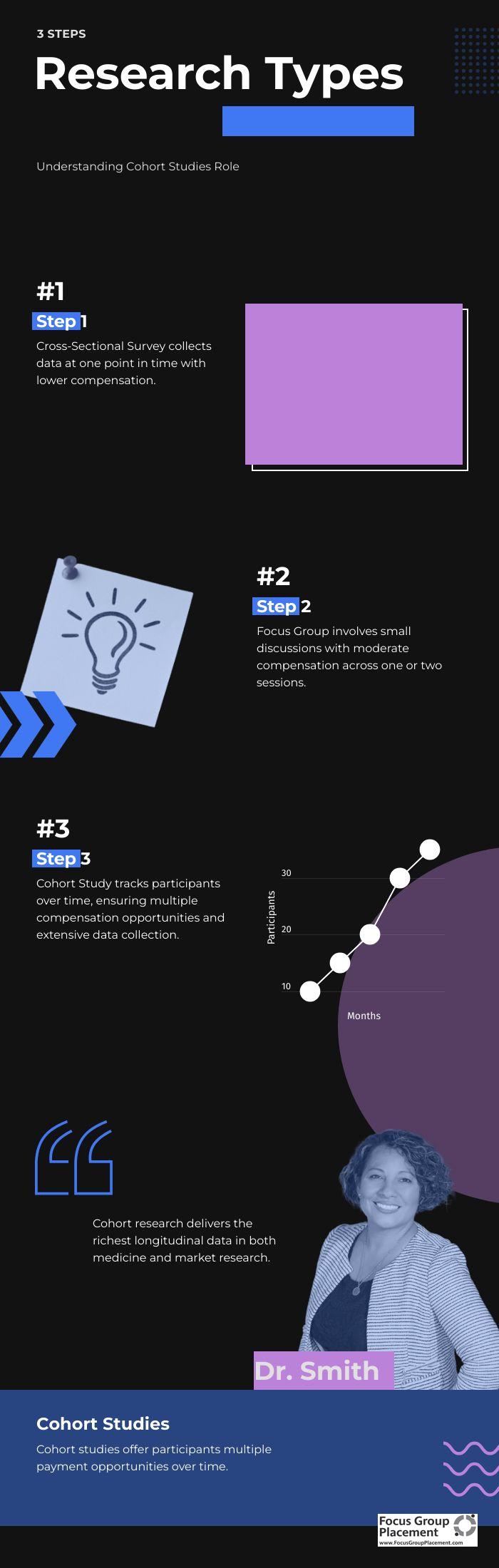
Outside clinical research, cohort methodology also plays a big role in consumer and market research. Cohort market research groups consumers by a shared characteristic — birth year or generation, the year they first bought a product, or when they were first exposed to a marketing campaign — and tracks how their behavior and preferences change over time. This helps companies understand not just what consumers do right now, but how their relationship with a brand evolves as circumstances and markets shift.
As a paid participant, cohort market research usually looks like a consumer panel or a longitudinal survey study. You might be recruited because you recently bought a car, became a parent, switched insurance providers, or started using a streaming service. Researchers want your experience and attitudes at multiple points, so you’ll be invited back for follow-up sessions, periodic surveys, or an ongoing panel where you report in regularly.
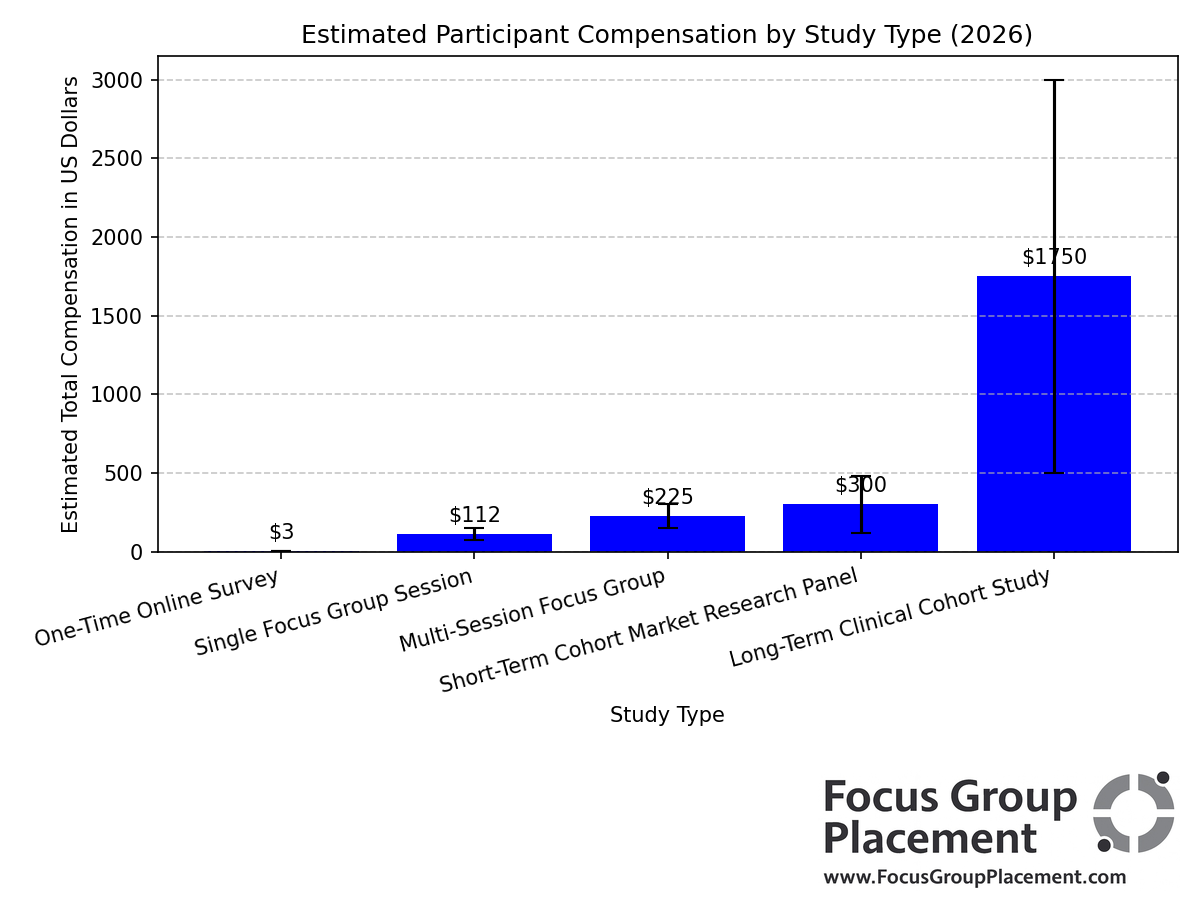
Because you’re contributing your time repeatedly, cumulative compensation across a cohort panel can add up to noticeably more than a single one-time focus group, though exact amounts vary by study and sponsor and are never guaranteed. Some longer-running panels involve diary studies, in-home product observations, or regular video-diary submissions, which typically pay more per session to reflect the extra time. The American Marketing Association considers cohort analysis one of the most useful tools in market research precisely because it captures change over time that a single static survey can’t.
If you want to explore focus group and market research opportunities in your area, browse current studies on Focus Group Placement, including opportunities that may involve multi-session cohort formats, or check the market research firms directory to find local firms that recruit for cohort-based consumer research.
Cohorts in Clinical Trials: What Research Participants Should Know
Clinical research is one of the more significant areas where cohort methodology gets used, and it can also be one of the more time-intensive options for participants willing to commit to a longer study. In clinical research, a cohort might refer to an arm of a study — a defined group receiving a specific treatment or dosage — or it might describe the full group of participants followed over time to see how a health condition or treatment affects outcomes. Understanding what a cohort means in this context clarifies the level of commitment and the type of data being collected before you apply.
When you apply to a clinical cohort study, you’ll typically go through a screening process to see whether you meet that cohort’s eligibility criteria — age, health status, medication history, smoking status, and similar factors. Screening does not guarantee acceptance. Once enrolled, you’ll follow a schedule of visits, data submissions, or check-ins that researchers use to track outcomes. The U.S. National Library of Medicine maintains a publicly searchable registry of federally registered clinical research studies — including active cohort studies — that you can search by condition, location, and age range. Searching for “observational cohort study” there is a reliable way to find studies that don’t require an experimental treatment.
Clinical cohort studies operate under strict ethical oversight through Institutional Review Boards (IRBs) in the United States, which means participants are protected by informed consent requirements, privacy protections, and the right to withdraw at any time. This regulatory framework is part of what makes clinical cohort research a legitimate, well-regulated way to contribute to scientific research while being compensated for your time.
Compensation for clinical cohort participation varies widely depending on the study’s length, procedures, and sponsor. Short cohort studies might offer modest payment over a month or two, while multi-year cohort studies can pay considerably more in total — often structured as payments per visit or per completed submission, disbursed only as milestones are actually met. If you’re interested in exploring clinical research options, Focus Group Placement lists clinical trial opportunities alongside focus groups and other studies in a single searchable directory.
How Cohort Studies Differ from Other Research Formats
One of the most common points of confusion for new research participants is how a cohort study differs from a focus group, a clinical trial, or a one-time online survey. Each format serves a different research purpose, involves a different level of commitment, and pays differently — so knowing the distinctions helps you match your availability and preferences to the right opportunities.
A focus group is typically a one-time, in-person or virtual group discussion led by a moderator, exploring consumer attitudes or behavioral motivations. Focus groups aren’t longitudinal — they capture data at a single point in time from a small group, usually six to ten people, and pay per session without repeated contact. A cohort study, by contrast, asks you to participate multiple times over an extended period, which means more total time but also more total compensation and a longer relationship with the research team. If you’re new to focus groups and want the basics, How Paid Focus Groups Work: A Beginner’s Guide on our blog is a good starting point.
Online surveys are typically anonymous, one-time data collection that pays little per completion — often a dollar or two, sometimes more for longer or specialized surveys. They’re convenient but don’t offer the depth of engagement or compensation that cohort studies provide. Clinical trials are the most structured and regulated form of research participation, involving specific interventions and medical oversight — they may use cohort methodology internally but are distinguished by their experimental design and clinical setting.
Knowing where cohort studies sit on this spectrum helps you evaluate opportunities more realistically. If you see a study advertised as a “longitudinal panel,” a “long-term consumer study,” or a “cohort research program,” expect multiple sessions, a defined schedule, and compensation that builds up across sessions rather than a single flat payment. The National Institutes of Health’s guide to clinical research participation is a useful external resource for understanding the full spectrum of study types.

How to Find and Join Cohort Research Studies
Finding legitimate cohort research opportunities comes down to knowing where to look and what to check before applying. The research landscape in 2026 offers more remote and hybrid formats than ever, which lets cohort studies recruit nationally instead of only locally. Whether you’re new to the concept or already an experienced participant, the steps below can help you find solid opportunities.
For market research cohort opportunities, start by registering with reputable research panels and market research firms in your area. Focus Group Placement’s market research firms directory is a useful starting point — it lists firms that run a range of study types, including longitudinal panels and cohort-based consumer research. Registering with more than one firm increases the chance you’ll be matched to a cohort study that fits your demographics and consumer profile.
For clinical cohort opportunities, check university medical center research pages, the National Library of Medicine’s clinical study registry, and dedicated clinical trial recruitment platforms directly. Read the study’s consent materials carefully before agreeing to participate, and ask the research coordinator specific questions about the visit schedule, procedures involved, and exactly when and how compensation is paid.
Whichever type of cohort study interests you, keep a few habits in mind: verify that the organization running the study is legitimate before sharing personal information, confirm the compensation structure and payment schedule up front, and be realistic about the time commitment across the full length of the study — not just the first session. A cohort study is a relationship that unfolds over months or years, and treating it that way from the start leads to a better experience for you and better data for the researchers.
Ready to find your next research opportunity? Browse current paid focus groups, cohort panels, and clinical studies on Focus Group Placement to see what’s actively recruiting near you.