
If you’re a teacher looking for meaningful ways to earn extra income outside the classroom, teacher focus groups represent one of the most rewarding and intellectually engaging opportunities available. Unlike generic side hustles, participating in education market research allows you to contribute your professional expertise—your hard-won knowledge of what works in classrooms, which tools help students learn, and what policies actually impact your daily work—and get paid well for sharing it. In 2026, the demand for educator insights has never been higher, driven by billions of dollars in EdTech investment, curriculum reform initiatives, and a surge in education-focused research across both the public and private sectors. This guide covers everything you need to know about finding, qualifying for, and maximizing your earnings from teacher focus groups and related education market research opportunities.
What Are Teacher Focus Groups and Why Do Companies Need Educators?
Teacher focus groups are structured research sessions in which a small group of educators—typically six to twelve participants—come together under the guidance of a trained moderator to discuss specific topics relevant to education. These sessions might explore a new learning management system, evaluate the clarity of a revised curriculum guide, assess the effectiveness of a classroom communication app, or provide candid feedback on a proposed school policy. The companies and organizations behind these studies include EdTech startups, major curriculum publishers, school supply manufacturers, nonprofit education research organizations, and even healthcare companies that recognize teachers as a distinct and influential demographic.
The reason companies seek out teachers so actively for market research is straightforward: educators are expert consumers with specialized knowledge that no amount of general consumer polling can replicate. A teacher who has spent fifteen years in a fifth-grade classroom understands intuitively what a new math curriculum is missing, what makes a classroom app genuinely useful versus gimmicky, and how a school supply product will actually hold up under daily use. That expertise is enormously valuable to product developers, and they are willing to pay a premium to access it. Because teachers are also difficult to recruit—their schedules are demanding, and they represent a relatively small percentage of the overall adult population—market research firms tend to compensate educators more generously than the average focus group participant.
In 2026, the topics that draw the most teacher focus group recruitment include artificial intelligence tools for education, student mental health resources, remote and hybrid learning technologies, assessment platforms, and teacher professional development programs. If you have experience in any of these areas, you are an especially sought-after participant in the current education market research landscape.
How Much Do Teacher Focus Groups Pay?
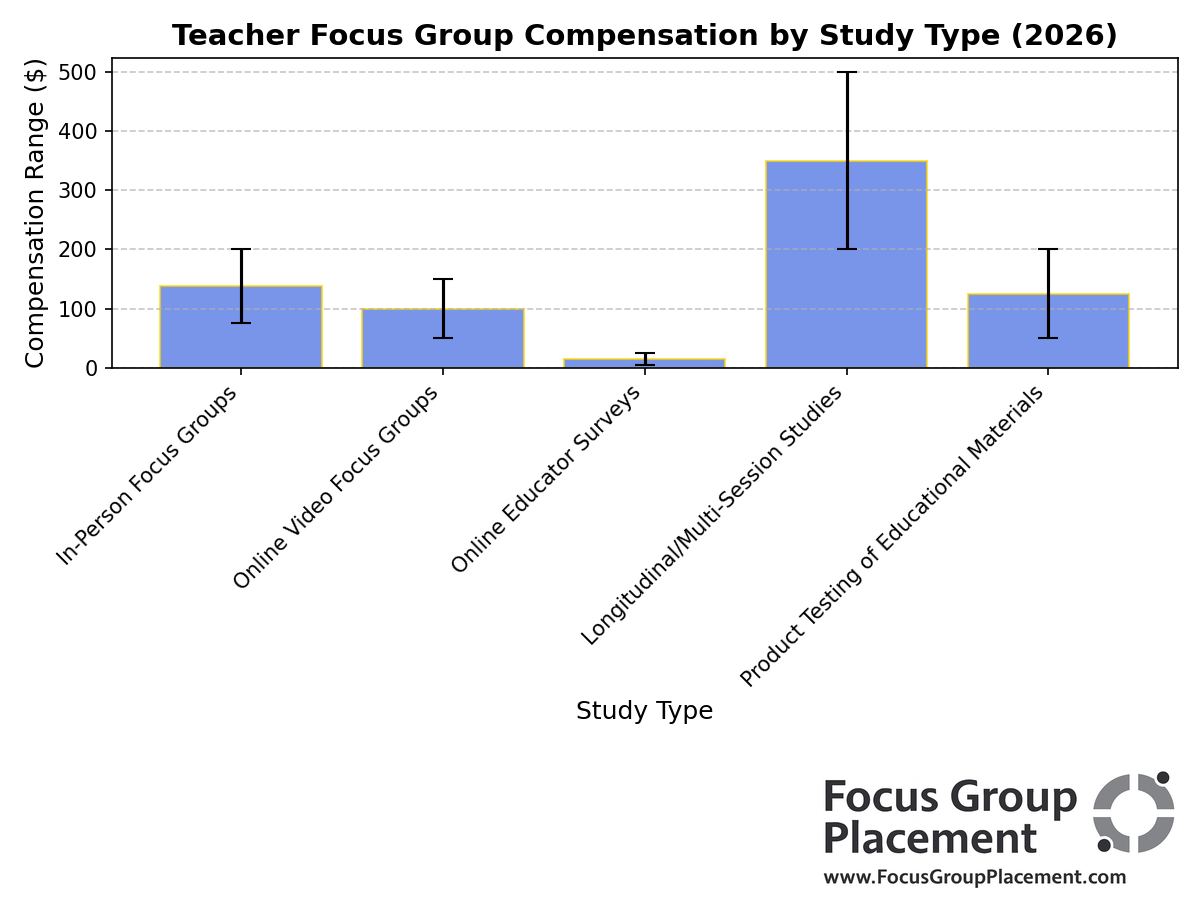
Compensation for teacher focus groups is genuinely impressive compared to most side income opportunities available to educators. In-person focus groups, which typically run between ninety minutes and two and a half hours, generally pay between $75 and $200 per session. Online video focus groups—which have become far more common since the pandemic normalized remote research—tend to pay in the $50 to $150 range, with the convenience of participating from home during evenings or weekends offsetting the slightly lower rate. Some premium sessions with highly specialized requirements, such as recruiting only STEM department heads with five or more years of administrative experience, can pay $200 to $300 or more for a single session.
Beyond traditional focus groups, teachers can participate in a broader range of education market research formats. Longitudinal studies, in which participants complete multiple check-ins over several weeks, can yield $200 to $500 or more in total compensation. Diary or journal studies, where teachers document their daily classroom experiences around a particular theme, often pay $100 to $300 for one to two weeks of participation. Online educator surveys are shorter and pay less—typically $5 to $25 per survey—but they require minimal time commitment and can be completed between classes or during a planning period. Product testing opportunities, in which educators receive educational materials, classroom technology, or school supplies to evaluate, often combine free products with cash compensation ranging from $50 to $200.
It is worth noting that teachers who maintain profiles with multiple market research firms and check in regularly for new opportunities can realistically earn $500 to $2,000 or more per year through education market research participation, without it significantly interfering with their primary career. The key is consistency and casting a wide net across different types of research formats.
How to Find Teacher Focus Groups and Educator Research Opportunities
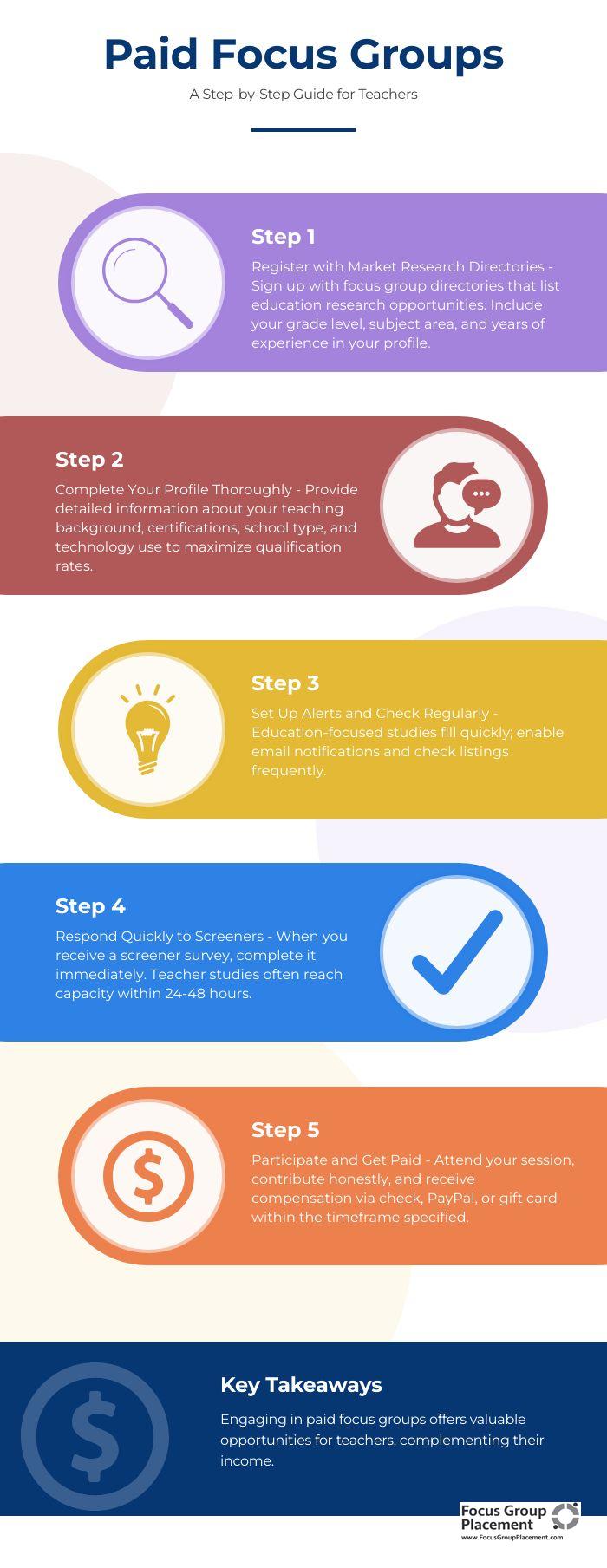
Finding teacher focus groups requires a multi-pronged approach, because opportunities are spread across market research firms, EdTech companies, academic institutions, and general research panels. The most efficient starting point is registering with a comprehensive focus group directory. Focus Group Placement maintains a directory of market research firms and research study opportunities, including both local in-person focus groups and national online studies, making it a practical resource for teachers who want to browse available opportunities in one place. Because the education research landscape is dynamic—new studies open and close regularly—it pays to check listings frequently rather than relying on a single registration.
Teachers should also research market research firms that specialize in education sector studies. Many firms that work with curriculum publishers, EdTech companies, and school districts maintain their own participant panels and recruit directly. Visiting the websites of major education research firms and signing up for their panels directly is another effective strategy. Additionally, professional organizations for teachers, such as subject-area associations and state teacher unions, sometimes partner with research organizations and share study opportunities with their members.
Academic institutions are another often-overlooked source of teacher focus group opportunities. Universities conducting education research frequently need practicing teachers as study participants, and these studies often come with IRB approval and professional legitimacy. Check the research pages of universities in your area, or look for calls for participants through education-focused social media groups and professional networks like LinkedIn.
For those interested in exploring market research firms in their area, Focus Group Placement offers a searchable directory organized by location, making it easy to find firms that conduct education research near you. If you are open to traveling to a nearby metropolitan area for higher-paying in-person sessions, you can also browse research opportunities by city to find sessions within a reasonable distance.
What to Expect When Participating in Education Market Research
The process of participating in a teacher focus group typically begins with a screener survey. This brief questionnaire—usually five to fifteen minutes long—confirms that you meet the specific criteria the research firm is looking for. For education-focused studies, screeners commonly ask about your grade level, subject area, years of teaching experience, the type of school you work in (public, private, charter, urban, rural), your familiarity with specific technologies or curricula, and sometimes your students’ demographic characteristics. Being honest and thorough on screeners is essential, both for ethical reasons and because researchers are looking for specific profiles—misrepresenting your qualifications can result in disqualification mid-study and forfeiture of compensation.
If you qualify, you will receive an invitation to participate. For in-person focus groups, you will be given a specific date, time, and location, along with instructions about what to bring and what to expect. Arrive a few minutes early, as many groups have strict start times and may not admit late arrivals. For online focus groups, you will receive a video conferencing link and may be asked to test your audio and video setup in advance. Online sessions are conducted through platforms like Zoom, Microsoft Teams, or proprietary research platforms, and you should ensure you have a reliable internet connection and a quiet, private space for the duration of the session.
During the focus group itself, a trained moderator will guide the conversation through a series of questions and activities. Your job is to share your honest, thoughtful opinions—there are no right or wrong answers. Researchers value candor above all else; they are specifically looking for authentic educator perspectives, not polished professional development responses. After the session, compensation is typically delivered by check, PayPal transfer, Venmo, virtual gift card, or sometimes in-person cash payment, depending on the firm. Payment timelines vary but generally range from immediate (for in-person cash payments) to four to six weeks (for mailed checks).
Educator Surveys: A Complementary Opportunity
While teacher focus groups offer the highest per-hour compensation, educator surveys provide a more accessible and lower-commitment way to earn money through education market research on an ongoing basis. These surveys are shorter—typically ten to thirty minutes—and cover many of the same topics as focus groups, from technology adoption to curriculum preferences to classroom management challenges. The trade-off is that they pay less per session, usually in the $5 to $25 range, but their convenience means they can be completed during lunch breaks, between classes, or in the evening without requiring travel or scheduling coordination.
Many general online survey platforms have education-focused segments within their panelist databases, and if you indicate your profession during registration, you will be routed to educator surveys when they become available. Beyond volume, the real value of educator surveys is that they keep your profile active within research firm databases, which can increase your likelihood of being recruited for higher-paying focus group opportunities. Think of educator surveys as both a standalone income stream and a relationship-building tool with the market research firms most likely to recruit you for premium studies in the future. If you are interested in exploring online survey opportunities as a complement to focus group participation, LevelSurveys is a reputable option with a $5 minimum payout, a points-based rewards system, multiple payment options, and 4+ star TrustPilot reviews.
Tips for Maximizing Your Earnings from Teacher Focus Groups
Teachers who approach focus group participation strategically tend to earn significantly more than those who sign up for a single study and wait passively for opportunities. The first and most important step is to register with multiple research firms and directories simultaneously, since different firms work with different clients and run different types of studies. The broader your presence in market research databases, the more frequently you will be contacted for studies that match your profile. Be sure to keep your profile information current—if you change grade levels, take on a new role, or gain experience with a new technology platform, update your profiles immediately, because these changes can open new study eligibility that did not exist before.
Responsiveness is equally critical. Education-focused focus groups fill quickly because the eligible participant pool is smaller than for general consumer studies. When you receive a screener or invitation, respond within a few hours if possible. Many studies are first-come, first-served among qualified participants, and delays of even a day or two can result in missing out entirely. Setting up email notifications from the research firms and directories you are registered with can help you stay ahead of opportunities.
Finally, treat your participation professionally. Arrive prepared, contribute substantively to discussions, and follow up on any post-session requirements promptly. Research firms maintain internal notes on participant quality, and being known as a thoughtful, engaged participant can lead to being personally recruited for future studies—including the highest-paying longitudinal and advisory panel opportunities that are not always publicly advertised. To learn more about how focus groups work and what to expect as a new participant, visit our guide on how to join focus groups.

Frequently Asked Questions About Teacher Focus Groups
Do I need special credentials to participate in teacher focus groups?
Most teacher focus groups require you to be a currently employed educator, though the specific requirements vary by study. Some studies accept teaching assistants, substitute teachers, or retired educators, while others specifically require full-time, credentialed classroom teachers with a minimum number of years of experience. Graduate students in education programs may qualify for some academic research studies. Always read the screener requirements carefully to determine whether you meet the specific criteria for a given study.
How long do teacher focus groups usually take?
In-person focus groups for educators typically run ninety minutes to two and a half hours. Online video focus groups tend to be slightly shorter, often sixty to ninety minutes. Longer sessions are less common but do occur, particularly for studies that involve evaluating a curriculum or technology platform in depth. Before committing to a study, confirm the expected duration so you can plan accordingly around your school schedule and personal commitments.
Can I participate in teacher focus groups during the school year?
Absolutely—and in fact, researchers often prefer it, because they want the perspective of actively teaching educators rather than those on summer break. Many online focus groups are specifically scheduled for evenings and weekends to accommodate teacher schedules. In-person groups are sometimes held immediately after school hours. If a session conflicts with your schedule, it is always better to communicate that clearly and ask about alternative dates than to accept an invitation you cannot honor, as no-shows can affect your standing with research firms.
Is income from teacher focus groups taxable?
Yes, income earned from focus group participation is considered taxable income in the United States. Research firms that pay you $600 or more in a single tax year are required to issue a 1099 form. Even if you receive less than $600 from a single firm, you are still technically required to report all income. It is advisable to keep a simple record of your earnings throughout the year and consult a tax professional if you have questions about how to report research participation income.
Are there focus group opportunities for school administrators and instructional coaches?
Yes, and these roles are often among the most sought-after in education market research. School principals, curriculum coordinators, instructional coaches, and district-level administrators make purchasing decisions that affect entire schools or districts, making their perspectives especially valuable to EdTech companies and curriculum publishers. If you hold an administrative or leadership role, you may qualify for premium studies with higher compensation than standard classroom teacher studies.
How do I find teacher focus groups near me?
The most efficient approach is to use a focus group directory that allows you to search by location. You can also register with reputable national research panels, since many teacher focus groups are now conducted online and are not limited to your immediate area. To improve your chances, create a detailed educator profile that includes your grade level, subject area, years of experience, certifications, and any curriculum or classroom technology you regularly use.