

If you have experience with banking, investing, or personal finance — or even if you simply have a checking account and a credit card — financial focus groups may be one of the most lucrative ways to earn extra money through research participation. These specialized studies are commissioned by banks, investment firms, fintech companies, insurance providers, and financial regulators who need direct feedback from real consumers and finance professionals. Unlike general consumer research, financial focus groups often pay premium rates because they require specific qualifications, and the insights they generate directly influence billion-dollar product decisions. Whether you’re a seasoned financial advisor or someone who simply manages a household budget, there’s likely a banking research study out there for which you qualify — and it may pay more than you expect.
What Are Financial Focus Groups and Who Conducts Them?
Financial focus groups are structured research sessions in which a moderator leads a small group of participants — typically six to twelve people — through a guided discussion about financial products, services, or experiences. These sessions can happen in person at a dedicated research facility, online via video conference, or through asynchronous formats like online bulletin boards and diary studies. The organizations commissioning these studies span the full breadth of the financial industry, and understanding who runs them helps you know where to look for opportunities.
Major retail banks and credit unions are among the most frequent sponsors of consumer banking research studies. They conduct focus groups to test new mobile app features, redesigned account statements, loan application processes, and branch service experiences. Fintech companies — particularly those in the mobile payment, robo-advisor, and digital lending space — also conduct extensive user research, especially before product launches. These studies often seek everyday users of competing apps, not just their own customers, which expands the pool of eligible participants considerably.
Investment firms and brokerage platforms regularly conduct research with retail investors, active traders, and high-net-worth individuals to evaluate portfolio tools, trading platforms, and educational content. Insurance companies run focus groups to test policy language, claims experiences, and new coverage products. On the regulatory side, agencies and consumer advocacy organizations commission banking research studies to understand how disclosures, fee structures, and financial products affect ordinary consumers — and these studies may pay particularly well because they require thoughtful, detailed feedback from a representative cross-section of the public.
Specialized market research firms serve as the intermediaries in most of these studies, handling recruitment, screening, and logistics on behalf of the sponsoring financial institution. Companies like Schlesinger Group and Fieldwork, as well as various boutique financial research firms, recruit participants for these studies on an ongoing basis. The Quirk’s Media directory is one industry resource that lists market research firms by specialty, including those focused on financial services. Registering with multiple research firms dramatically increases your chances of being selected for financial focus groups in your area or online.
How Much Do Financial Focus Groups Pay?
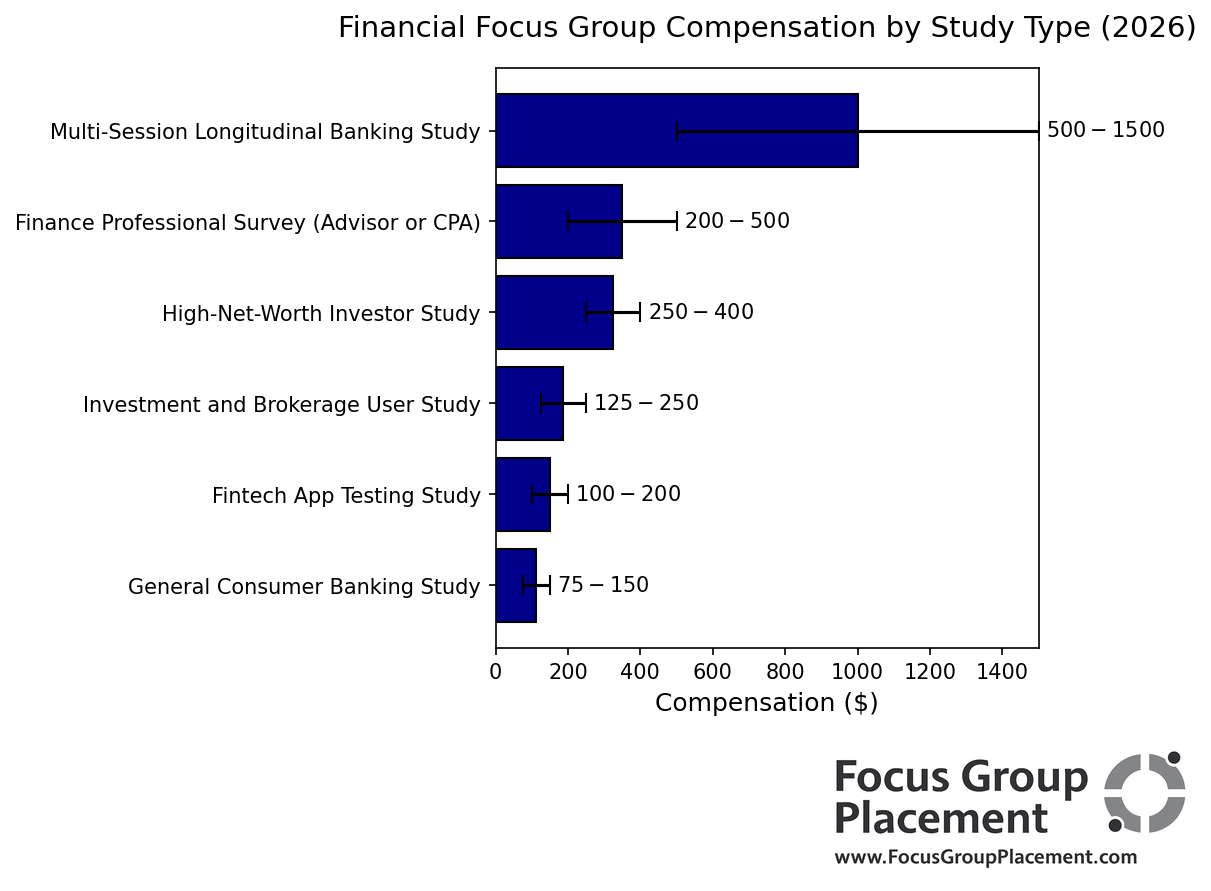
Compensation is one of the most compelling aspects of financial focus groups, and the pay rates in this category are consistently higher than in general consumer research. The reason is straightforward: financial institutions need participants who meet very specific criteria, and recruiting qualified individuals requires offering incentives that make participation worth their time. Session length, study format, and the level of specialization required all influence what you’ll earn.
For general consumer banking studies — which might target anyone who has a checking or savings account — participants typically earn between $75 and $150 for a session lasting 60 to 90 minutes. These studies might explore reactions to a new bank website, opinions about mortgage application processes, or feelings about overdraft fee policies. While anyone with a bank account might qualify, showing up prepared and articulate can make you a preferred participant whom recruiters invite back repeatedly.
Finance professional surveys represent the premium tier of this opportunity landscape. If you are a certified financial planner (CFP), CPA, investment advisor, bank loan officer, mortgage broker, or hold a similar credential, you can expect compensation ranging from $200 to $500 per session — sometimes more for complex or longer engagements. Financial institutions specifically seek professionals because their feedback on technical product features, regulatory compliance tools, or B2B financial software carries far more weight than general consumer opinion. Some multi-session studies targeting finance professionals pay $500 to $1,500 or more across the full engagement.
High-net-worth investor studies occupy their own compensation category. If you have a brokerage account with $250,000 or more in investable assets, or if you actively manage your own stock and options portfolio, investment firms will pay premium rates — often $250 to $400 per session — to hear your perspectives on trading platforms, research tools, and wealth management services. These studies are less frequently available than general banking research studies, but when they arise, they offer exceptional value for your time.
Online financial surveys (as opposed to full focus groups) typically pay less, in the range of $25 to $75, because they require less time and involve less interaction. However, they’re also easier to qualify for and can be completed from home on your own schedule, making them a good complement to higher-paying focus group participation.
Qualifying for Financial Focus Groups: What Screeners Look For
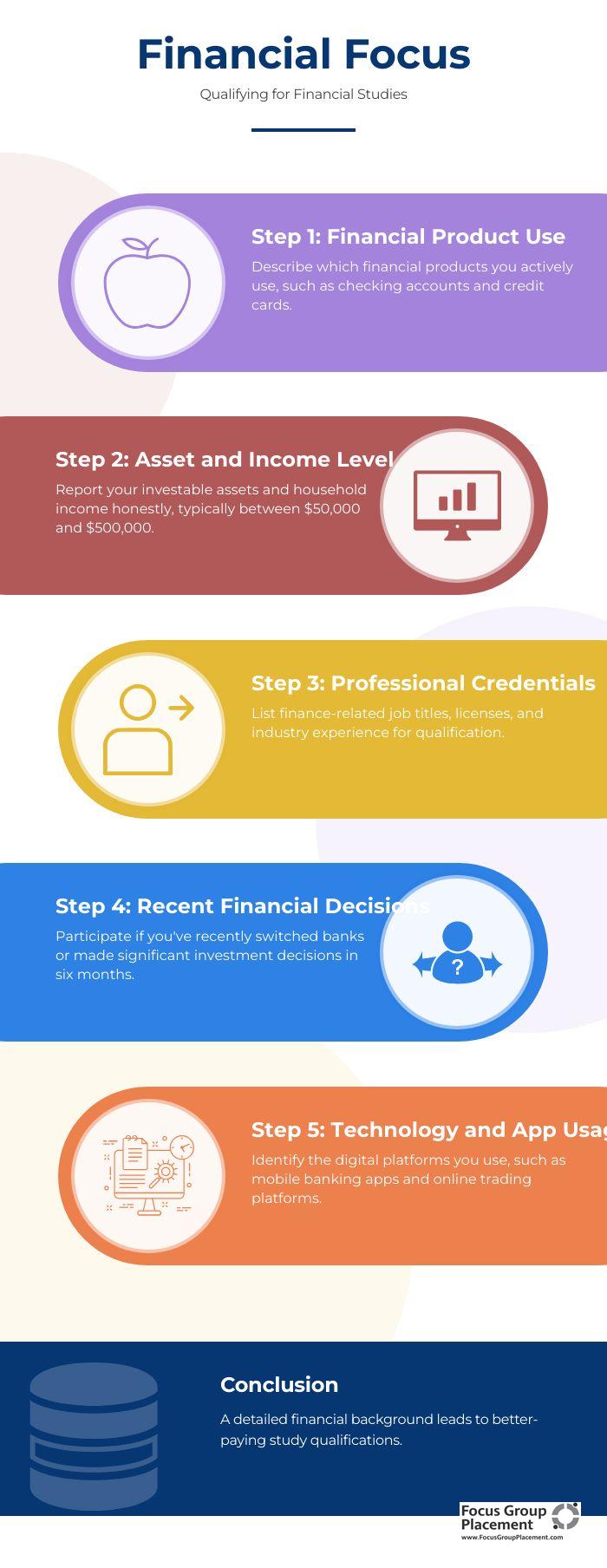
Every financial focus group begins with a screener — a short questionnaire designed to determine whether you meet the study’s specific criteria. Understanding what these screeners look for puts you in a stronger position to apply strategically and get selected. The qualification requirements for banking research studies vary widely depending on the study’s objectives, and they generally fall into a few broad categories.
Demographic and financial product qualifications are the most common screening criteria for general consumer studies. You might need to have a specific type of account (checking, savings, money market, investment brokerage, home equity line), use a particular financial app, carry a specific brand of credit card, or have recently applied for a mortgage or personal loan. Studies sometimes specify that participants must have made a financial decision within a certain timeframe — for example, having switched banks, opened a new investment account, or applied for a loan within the past six months — because recent experience means fresh, relevant memories and opinions.
Asset and income thresholds appear in studies targeting investors and affluent consumers. A research firm recruiting for a wealth management platform might screen for participants with at least $100,000 in investable assets, or a credit card company might seek participants with an annual household income above $75,000. These thresholds are used to ensure that participants actually use the types of products or services being researched. Being honest about your financial situation during screeners is important both ethically and practically — misrepresenting your qualifications can result in being disqualified mid-study and forfeiting your compensation.
Professional credentials and employment qualifications are essential for finance professional surveys. Research firms will typically ask about your job title, years of experience, the type of firm you work for, and sometimes your professional licenses or certifications. If you work in financial services — whether as an advisor, analyst, banker, insurance agent, or compliance officer — you should actively highlight this background when registering with research platforms and completing screeners, because it opens the door to significantly higher-paying studies.
Where to Find Legitimate Banking Research Studies and Financial Focus Groups
Finding legitimate financial focus groups requires knowing where to look and registering proactively rather than waiting for opportunities to come to you. The good news is that the financial research industry is robust and active in 2026, with more studies than ever being conducted online — which means geographic location is less of a barrier than it once was.
One of the most practical starting points is a dedicated focus group directory like Focus Group Placement, which aggregates research opportunities from a wide range of market research firms. The directory includes both local in-person opportunities and national online studies, spanning multiple research categories including financial services. You can browse opportunities by city if you’re interested in attending an in-person session at a research facility near you, or look for national online studies that can be completed from home. If you’re interested in connecting directly with the research firms that conduct financial studies, Focus Group Placement also maintains a directory of market research firms where you can register directly with multiple companies at once.
Registering directly with market research firms that specialize in financial services is another effective strategy. Many boutique firms focus exclusively on financial, banking, and investment research and maintain their own participant databases. Reaching out proactively and completing your profile thoroughly — including detailed information about your financial products, professional background, and investment activity — ensures that you’ll be contacted when a matching study becomes available. The more complete and specific your profile, the more likely recruiters are to reach out when a study matches your qualifications.
Professional networks and industry associations can also be valuable channels for finance professionals specifically. Recruiters for finance professional surveys sometimes post opportunities in LinkedIn groups for financial advisors, accounting professionals, or banking industry employees. If you’re a member of professional associations like the Financial Planning Association or the American Institute of CPAs, keep an eye on member communications for research participation opportunities, which are sometimes shared as member benefits.
For those interested in how to get started with focus group participation more broadly, our guide on how to join focus groups provides a solid foundation for understanding the process from registration through payment. If you’re based in a major financial hub, city-specific directories can also help you find in-person banking research studies: check out opportunities in New York or Chicago, both of which host significant volumes of financial industry research.
What to Expect During a Financial Focus Group

If you’ve never participated in a financial focus group, knowing what to expect can help you feel confident going in — and can make you a more valuable participant, which increases your chances of being invited back. The experience differs somewhat depending on whether the session is in-person or online, but the core structure remains consistent across formats.
In-person financial focus groups are typically held at professional market research facilities located in office buildings, often in financial districts or commercial centers. You’ll arrive about 15 minutes early, check in with a receptionist, and may be asked to fill out a short consent form and demographic questionnaire. The session itself takes place in a comfortable conference room with a moderator who leads the discussion. A one-way mirror is common in traditional research facilities, allowing observers from the sponsoring company to watch without participating — this is standard practice and nothing to be concerned about. Sessions typically run 60 to 90 minutes and cover a structured set of topics related to the study’s subject matter, whether that’s a new banking app interface, a retirement savings product, or investment fee transparency. Payment is usually made at the end of the session in cash, check, or a prepaid card.
Online financial focus groups have become increasingly standard, particularly since 2020, and they’re now the preferred format for many participants because of the convenience factor. These sessions are conducted via video conferencing platforms and follow a similar structure to in-person groups, with a moderator guiding discussion among a small group of participants. You’ll need a reliable internet connection, a functioning webcam and microphone, and a private, quiet space. The technical barrier is minimal, and most platforms used by research firms are straightforward to navigate. Payment for online sessions is typically made via PayPal, Venmo, Zelle, or digital gift card within a few days of completing the study.
Online bulletin board studies are an asynchronous format that’s particularly common in financial research. Rather than participating in a live session, you’re given access to a private online community where a moderator posts questions and tasks over the course of several days — usually five to seven. You log in daily and spend 20 to 30 minutes responding to prompts, reacting to other participants’ comments, or completing assigned tasks like reviewing a sample bank statement or evaluating a mock investment dashboard. This format offers maximum flexibility and can pay well relative to the time commitment, making it popular among finance professionals whose schedules make live session attendance difficult.
Financial Focus Groups for Finance Professionals: A Higher-Paying Opportunity
Finance professionals occupy a uniquely advantageous position in the market research ecosystem. If your professional life involves managing money, advising clients on financial decisions, working within a bank or credit union, or building financial technology, you are part of a small and highly sought-after participant pool that commands premium compensation. Understanding this advantage and leveraging it proactively can turn finance professional surveys into a meaningful side income stream.
The reason compensation is so much higher for finance professionals comes down to the value of the insight. When a major brokerage firm wants to understand how financial advisors evaluate competing platforms, or when a bank wants to improve its commercial lending software, they need input from people who use these tools every day — not general consumers with only a surface-level understanding of the industry. Your firsthand knowledge of workflows, compliance requirements, client expectations, and purchasing decisions gives researchers access to insights they cannot obtain elsewhere, which is why financial focus groups often pay significantly more than standard consumer studies.