
If you work in information technology, your expertise is worth far more than your salary alone suggests — especially when it comes to IT focus groups and technology professional research. While the average consumer can earn $50 to $100 for sitting in a standard focus group, IT professionals routinely command two to five times that amount for participating in the same type of research session. Companies building enterprise software, cybersecurity platforms, cloud infrastructure tools, and developer environments desperately need feedback from people who actually use these systems day to day. That demand, combined with the relative scarcity of qualified technical participants, has created a robust and lucrative market for IT professionals willing to share their expertise through IT focus groups and related research engagements.
This guide covers everything you need to know about participating in IT focus groups and technology-focused research studies in 2026, from where to find opportunities and what types of studies exist, to how to position your credentials for maximum earning potential. Whether you’re a software developer, systems administrator, cybersecurity analyst, network engineer, or IT manager, your specialized knowledge is a genuine asset in the research marketplace. IT focus groups are one of the most underutilized income opportunities available to technology professionals today, and understanding how to navigate this space can meaningfully supplement your primary income.
Why IT Focus Groups Pay Premium Rates
The economics of technology professional research are fundamentally different from general consumer market research, and understanding that difference helps explain why IT professionals can earn so much more per hour from IT focus groups. When a consumer goods company wants feedback on a new snack food or household cleaner, they can recruit virtually anyone — the participant pool is essentially the entire adult population. When a software company wants feedback on a new enterprise security information and event management (SIEM) platform, they need SOC analysts and cybersecurity engineers who are actively working with these tools. That pool is dramatically smaller and much harder to recruit, which is precisely why IT focus groups pay so much more than general consumer research sessions.
Recruiting a qualified IT professional for a research study requires matching on multiple dimensions simultaneously: job title, years of experience, company size, industry vertical, specific technology stack, and sometimes certifications or budget authority. A study seeking feedback on a cloud-native Kubernetes management platform might need participants who are currently working as DevOps engineers or platform engineers at companies with more than 500 employees, actively managing containerized workloads. Finding and recruiting even 8–12 of those participants for a single IT focus group is genuinely difficult work for research firms, and the scarcity premium flows directly to the participants themselves.
This scarcity dynamic means that technology companies building enterprise products treat participant recruitment as a genuine investment. They’re not just running obligatory research — they’re using these sessions to inform roadmaps, prioritize features, and validate pricing models. The insights from a two-hour IT focus group with eight qualified engineers can directly influence product decisions worth millions of dollars in development investment. Paying participants $200–$400 for their time is a trivially small line item compared to that value, which is why the compensation rates for IT focus groups are so much higher than general consumer research. Understanding this dynamic helps IT professionals recognize that they hold genuine leverage in the research marketplace.
Types of IT Focus Groups and Technology Research Opportunities
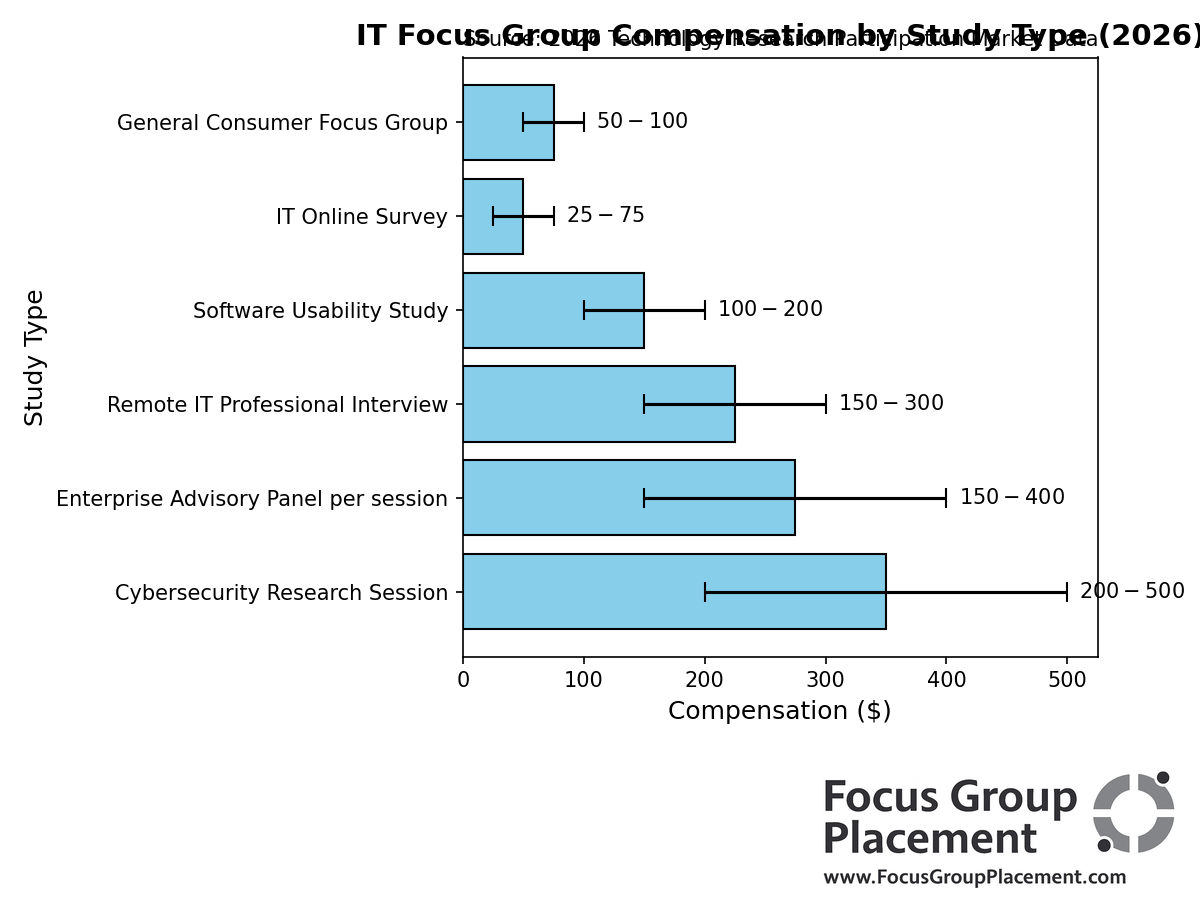
The landscape of technology professional research is broader than most IT workers realize, and the variety of IT focus groups and related study formats means there are opportunities suited to virtually every type of technology professional. Software user studies are perhaps the most common format, involving usability testing of enterprise applications, developer tools, dashboards, or workflow platforms. In these sessions, participants typically complete specific tasks within a software interface while narrating their thought process, with a UX researcher observing and asking follow-up questions. These sessions often run 60–90 minutes and pay $100–$200, though compensation for enterprise software studies can reach $250 or more depending on the specificity of credentials required.
Cybersecurity research represents one of the highest-paying niches within IT focus groups. Security tool vendors, threat intelligence companies, and enterprise security teams actively recruit SOC analysts, CISOs, penetration testers, and incident response professionals for focused research sessions. These studies might involve evaluating new detection capabilities, exploring threat hunting workflows, or providing expert input on security architecture decisions. Given how difficult it is to recruit genuine security professionals with hands-on experience, compensation for these sessions frequently ranges from $200 to $500 per engagement — making cybersecurity-focused IT focus groups among the most lucrative research opportunities available to any professional in any field.
Enterprise technology advisory panels are a longer-term research relationship that can be even more lucrative than individual IT focus groups. Some technology companies maintain ongoing advisory panels of IT professionals who participate in monthly or quarterly research activities, providing feedback on product direction, evaluating prototypes, and weighing in on strategic decisions. These ongoing relationships can generate $500 to $2,000 or more per year from a relatively modest time commitment. They also tend to offer early access to unreleased software, which has professional development value beyond the direct compensation and can keep your skills current with emerging enterprise tools.
Remote moderated user interviews have become one of the dominant formats in technology professional research since the widespread adoption of remote work. These are typically one-on-one video calls between the participant and a UX researcher, running 45 to 90 minutes, during which the researcher probes deeply into the participant’s workflows, pain points, and opinions about specific tools or concepts. This format is ideal for IT professionals because it requires no travel, can be scheduled around work commitments, and the one-on-one depth means researchers can justify higher compensation rates. Payments of $150–$300 for a single 60-minute remote interview are common on platforms like User Interviews and Respondent.io.
Beta testing programs for enterprise software represent another opportunity that blurs the line between research participation and professional development. Enterprise software vendors regularly recruit IT professionals to use pre-release versions of their products in real or simulated work environments, providing structured feedback over weeks or months. These extended engagements typically pay more in aggregate, often $300–$1,000+ for a full beta program, though the per-hour rate may be lower than a concentrated IT focus group session. The combination of compensation and early access to cutting-edge tools makes beta programs particularly attractive to IT professionals who want to stay ahead of industry trends.
Top Platforms for Finding IT Focus Group Opportunities
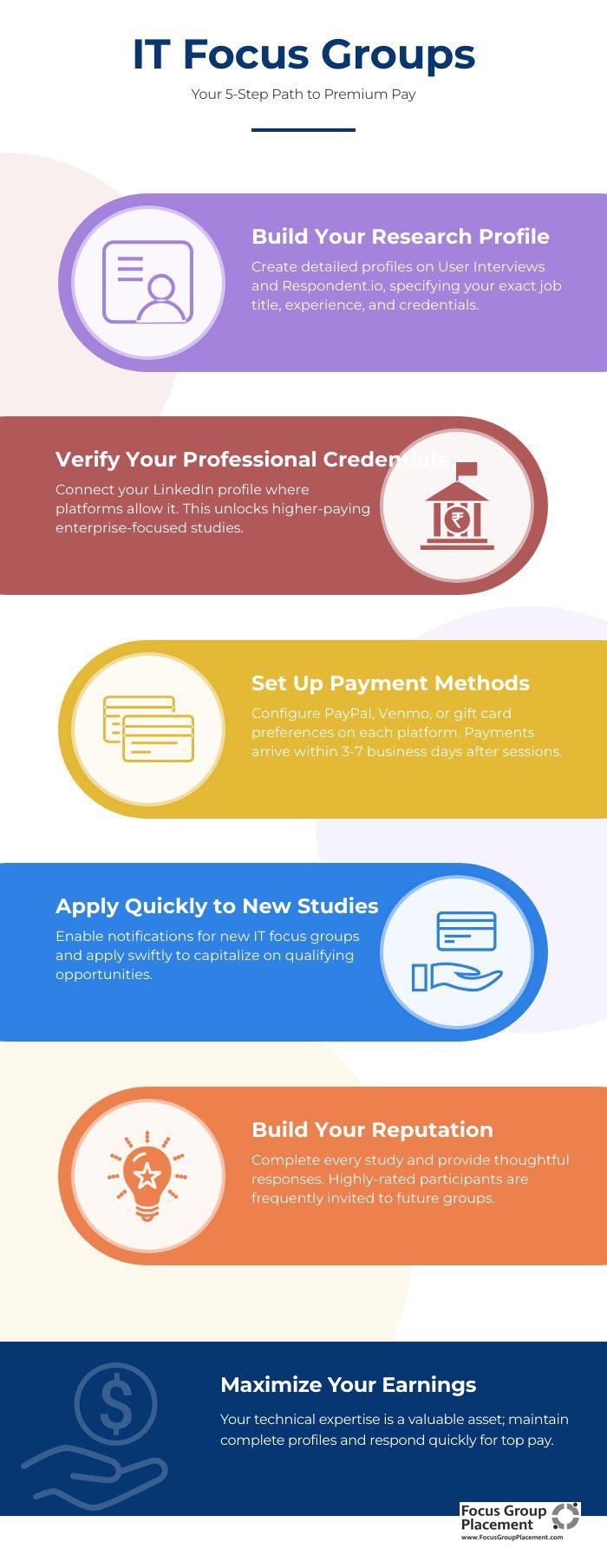
User Interviews has established itself as the largest marketplace specifically connecting research participants with companies running professional studies. The platform is particularly strong for technology professional research because it allows researchers to filter participants by profession, and the participant pool skews heavily toward knowledge workers. IT professionals who create a detailed profile specifying their job title, years of experience, technologies they use, and company characteristics report finding qualifying IT focus groups and user studies regularly. The platform shows you studies you’re eligible for based on your profile, and compensation is clearly listed upfront, typically delivered via gift card or PayPal within a few days of completing a study.
Respondent.io has carved out a strong reputation specifically for high-paying B2B professional research, and IT professionals frequently report it as one of their most lucrative research participation platforms. The studies available through Respondent tend to target business professionals rather than general consumers, and the compensation reflects that focus — it’s not uncommon to see software user studies and enterprise technology interviews paying $150–$400 for an hour of time. The platform requires connecting your LinkedIn profile during registration, which helps verify professional credentials and actually increases your likelihood of qualifying for high-value IT focus groups and research sessions.
For IT professionals interested in in-person IT focus groups or local research opportunities, Focus Group Placement offers a comprehensive directory of focus groups and market research firms that can be browsed by location. Technology companies and research firms conducting in-person sessions in major tech hubs frequently post opportunities through directories like this one. You can browse by city to find research firms in your area, or explore the market research firms directory to identify firms that specialize in technology research in your region. Focus Group Placement also lists clinical trial opportunities, product testing opportunities, and online surveys, making it a useful single destination for IT professionals who want to diversify their research participation income.
UserTesting.com focuses specifically on usability and UX research, making it a natural fit for IT professionals who work with software interfaces regularly. The platform operates somewhat differently from the others — participants complete recorded video sessions demonstrating their use of websites or applications, often without a live researcher present. Compensation per session is lower (typically $10–$30), but the sessions are short (15–20 minutes) and available in higher volume, making it a useful supplemental income stream for IT professionals who want frequent, flexible earning opportunities alongside higher-paying IT focus groups.
How to Maximize Your Earnings from IT Focus Groups
The single most important factor in maximizing your earnings from IT focus groups and technology professional research is the completeness and specificity of your profiles on research platforms. Generic profiles that simply say “IT professional” perform significantly worse than detailed profiles that specify your exact job title (Senior DevOps Engineer, Information Security Analyst, Enterprise Architect), the specific technologies you use daily (AWS, Azure, Terraform, Splunk, ServiceNow, Salesforce), your industry vertical, and the size of your organization. Researchers use these details to filter potential participants, and the more specifically your profile matches their criteria, the more frequently you’ll be invited to IT focus groups and user studies — and the more those studies will pay.
Professional certifications are surprisingly powerful signals in the research marketplace. Holding active certifications like AWS Solutions Architect, CISSP, CCNP, PMP, or Google Cloud Professional immediately places you in a much smaller, more valuable pool of potential participants. Cybersecurity certifications in particular — CISSP, CEH, OSCP, CompTIA Security+ — significantly increase qualification rates for security research studies, which tend to be among the best-compensated IT focus groups available. List every current and relevant certification on your research profiles, as these credentials directly influence which studies you’re invited to and how much those studies pay.
Decision-making authority is another major compensation multiplier in the IT focus groups marketplace. IT professionals who have purchasing authority or significant influence over technology procurement decisions are far more valuable to enterprise software vendors than individual contributors with no budget responsibility. If you’re an IT manager, director, or executive with budget authority for technology purchases, emphasize this explicitly in your profiles. Studies targeting IT decision-makers routinely pay $300–$600 per session because the research insights directly inform sales and marketing strategy for companies selling enterprise software worth hundreds of thousands of dollars annually.
Responsiveness and reliability are qualities that compound over time in the research participation ecosystem. Platforms like User Interviews allow researchers to rate and review participants, and a strong reputation for showing up prepared, providing thoughtful answers, and being easy to work with leads to repeat invitations and direct recruits from researchers who remember you from previous IT focus groups and user studies. Some IT professionals develop ongoing relationships with specific UX research teams at companies they’ve worked with, resulting in consistent paid opportunities that never appear in public participant marketplaces. These private relationships represent the highest tier of research participation income and are built entirely through demonstrated reliability and insight quality.
If you’re also interested in exploring other research participation opportunities beyond IT-specific focus groups — including clinical trial opportunities, product testing, and general online surveys — Focus Group Placement maintains a regularly updated directory that spans multiple research categories. While IT focus groups represent the premium tier of research compensation, diversifying your research participation across multiple opportunity types can meaningfully increase your total annual earnings from this activity. You can also read more about how to join focus groups generally if you’re new to research participation.

What to Expect During an IT Focus Group Session
Understanding what actually happens during an IT focus group session helps professionals prepare effectively and get the most out of the experience — both in terms of earnings and the quality of their contribution. Most technology-focused sessions begin with a brief introduction from the moderator or researcher, who will explain the purpose of the study at a high level, outline what confidentiality protections are in place (most IT focus groups require a non-disclosure agreement), and set expectations for how the discussion will be conducted. Participants may then be asked to describe their professional background, the tools and systems they use, the size of their organization, and the types of technology decisions they influence. From there, the session typically moves into guided questions, product reactions, workflow discussions, or feedback on specific software concepts, with the moderator encouraging honest, practical input rather than polished sales-style answers.