

Updated for 2026: This YouGov surveys review summarizes realistic earnings, how the points system works, redemption options, and where YouGov fits beside higher-value paid focus groups, interviews, and product-testing studies.
If you’ve ever searched for ways to earn extra money from home, you’ve almost certainly come across YouGov — one of the world’s most recognizable names in public opinion research and online surveys. But between the platform’s reputation for polling politicians and tracking brand sentiment, many people wonder whether YouGov actually pays its panel members meaningful money, or whether it’s just another survey site that promises rewards and delivers pennies. This comprehensive YouGov review breaks down exactly how the platform works in 2026, what you can realistically expect to earn, how the points system functions, and whether joining the YouGov panel is worth your time.
What Is YouGov and How Does the YouGov Panel Work?
YouGov is a global data and research company founded in 2000 in the United Kingdom. Over the past two decades, it has grown into one of the most prominent public opinion firms in the world, with panel members in more than 55 countries and a client roster that includes major corporations, political parties, governments, and media organizations. When you sign up as a YouGov panel member, you’re not just filling out generic surveys — you’re contributing to research that actually gets published, cited in news outlets, and used by brands and policymakers to make real decisions. You can learn more about the company’s history and global reach by visiting the YouGov website directly.
The YouGov panel operates on a straightforward model: the company recruits everyday consumers and voters to answer questions about topics ranging from politics and social issues to consumer preferences, brand perceptions, and product categories. In exchange for your time and opinions, YouGov compensates you with points that can be redeemed for cash or gift cards once you accumulate enough. The panel is free to join, requires no special skills or qualifications, and is open to anyone aged 18 or older in an eligible country. In the United States, YouGov operates its panel through YouGov America, which focuses heavily on political polling, consumer research, and media studies.
Signing up is a simple process. You create a free account on the YouGov website, complete an initial profile survey that captures your demographic information, and then begin receiving survey invitations tailored to your background. YouGov uses your profile data to match you with relevant studies — which means that the more completely you fill out your profile, the more survey invitations you’re likely to receive. After registration, invitations are delivered both by email and through the YouGov mobile app, which is available for iOS and Android devices and allows you to complete surveys and monitor your points balance on the go.
Understanding YouGov Earnings: The Points System Explained
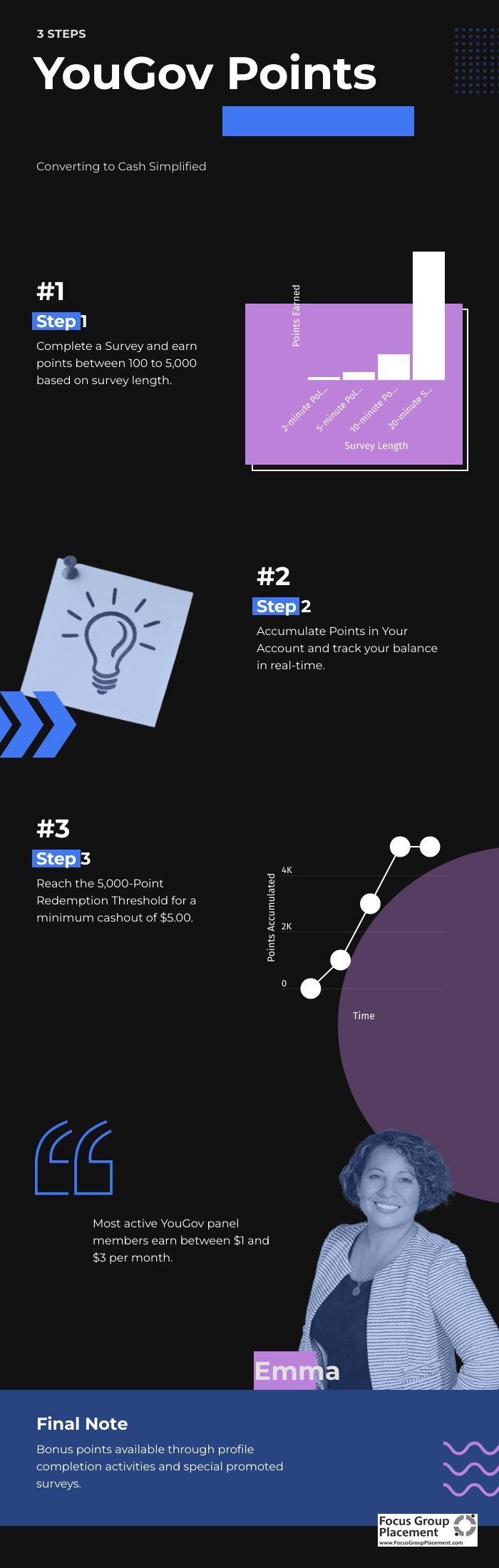
The heart of any paid survey platform is its compensation structure, and understanding exactly how YouGov earnings work is essential before you invest your time. YouGov uses a points-based system where every completed survey earns you a certain number of points, which are then redeemable for real-world rewards once you accumulate enough. How much are YouGov points worth? Check the Rewards section in your account: YouGov’s U.S. redemption guide says each reward displays the points required to claim it. Its public guidance does not establish a universal 5,000-points-for-$5 conversion.
YouGov says survey points vary with the length and complexity of the survey, with longer and more complex surveys receiving more points. Because awards vary, a fixed points-per-survey rate is not a reliable basis for estimating monthly earnings.
To find your cash-out requirement, log in and open Rewards. Each option shows the points required. YouGov’s U.S. cash-redemption guide describes bank transfers; the amounts available depend on your points balance and verification status. YouGov also documents gift cards and a Tremendous Visa Reward Card. Check your current reward options rather than assuming a particular brand, payment method or minimum is available to every member.
Invitations vary over time, survey point awards vary, and the points needed depend on the reward you select. Treat participation as an opportunity to earn rewards, not a predictable monthly income.
YouGov Survey Frequency: How Often Will You Actually Get Invited?
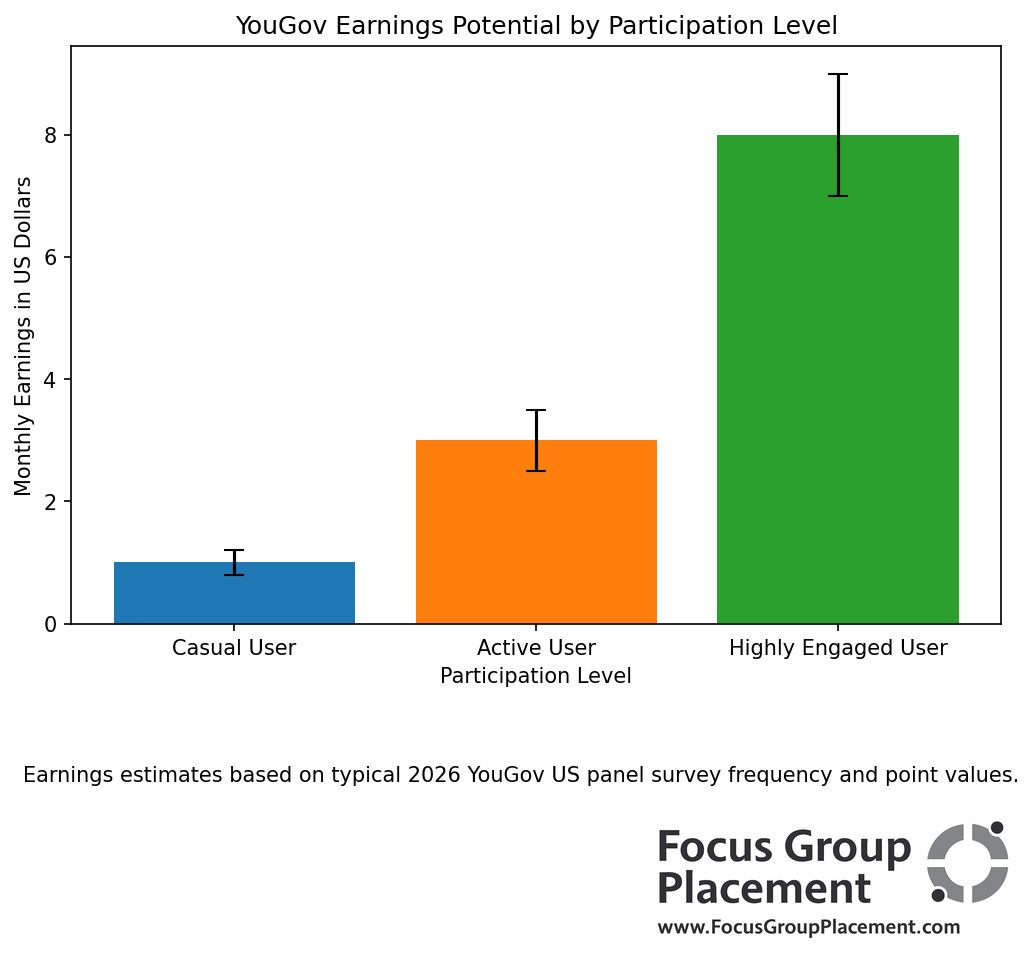
One of the most common frustrations among paid survey panel members is the gap between expected and actual survey frequency. YouGov is reasonably transparent about this: the number of YouGov surveys you receive depends heavily on your demographic profile, your location, and whether your characteristics match the target audiences for active research projects. YouGov says invitation volume varies over time and depends on research taking place in your country or region; it selects a representative sample rather than inviting every member to every survey.
It’s worth noting that YouGov’s research calendar tends to accelerate around major political events. During election seasons, members often notice a marked increase in political polling surveys, sometimes receiving daily invitations. Outside of election cycles, the frequency may slow down, particularly for members whose demographic profiles are less frequently targeted by consumer research. If you find yourself receiving fewer invitations than you’d like, the most effective strategy is to ensure your profile is fully and accurately completed, as YouGov uses profile data to match members to relevant studies.
YouGov also distinguishes between standard surveys, which are open to any panel member who matches the basic criteria, and targeted surveys, which are sent only to members with specific demographic characteristics. Targeted surveys often pay better and take longer, but they also mean that not every member will qualify for every available study. This is a normal feature of professional market research — researchers need specific respondent profiles to produce valid data — but it can feel frustrating if you’re screened out of a high-value survey after answering several qualifying questions. Understanding this dynamic upfront helps set realistic expectations about how often you’ll be able to complete surveys and accumulate points.
Is YouGov Legitimate? Evaluating the Platform’s Credibility
One of the first questions anyone asks about a survey platform is whether it’s actually legitimate or just another online scam. In the case of YouGov, the answer is definitively yes — it is a legitimate, well-established research company with more than two decades of operational history, a publicly traded status on the London Stock Exchange, and a client base that includes major corporations and governments worldwide. YouGov does pay its panel members. The rewards are modest but real, and the platform has a verifiable track record of honoring its points redemption commitments.
User reviews on independent platforms reflect a generally positive but realistic picture. Panel members consistently praise the platform for its ease of use, the quality of its surveys (which often address genuinely interesting current events and policy topics), and the reliability of its payment processing. Common criticisms center on survey frequency being lower than expected, occasional screening-out experiences, and the slow pace of point accumulation for users who don’t qualify for many targeted studies. These are limitations shared by virtually all online survey panels, and they reflect the inherent nature of market research rather than any dishonest behavior on YouGov’s part.
For anyone who wants to maximize their research-based earnings beyond what YouGov alone can provide, it’s worth considering complementary opportunities. Focus groups, for example, typically pay far more per session than online surveys — often $75 to $200 or more for a single one-to-two-hour session. If you’re interested in supplementing your YouGov earnings with higher-paying research opportunities, Focus Group Placement maintains a comprehensive directory of focus groups, clinical trials, product testing opportunities, and online surveys from research firms across the country. Exploring multiple research participation channels is the most effective way to build meaningful supplemental income from sharing your opinions.
YouGov vs. Other Survey Platforms: How Does It Compare?
YouGov occupies a somewhat unique position in the paid survey landscape because of its strong brand identity and its emphasis on public opinion research rather than purely commercial consumer studies. Unlike many survey platforms that focus almost exclusively on brand and product research, YouGov surveys frequently cover political topics, media consumption habits, social attitudes, and policy preferences. This makes the YouGov panel particularly appealing to people who are genuinely interested in current events and enjoy seeing their opinions reflected in published research and news stories.
In terms of pure earning potential, YouGov is comparable to most mid-tier survey platforms. Before comparing earning potential with other platforms, check the points required and reward options shown in your YouGov account. Those who are specifically interested in paid online surveys and want to compare platforms should look at options like LevelSurveys, which offers a similar points-based model with a $5 minimum payout, multiple redemption options, and 4+ star TrustPilot reviews. Diversifying across multiple legitimate survey platforms is generally the best strategy for maximizing your monthly survey earnings, since no single platform provides enough survey volume to generate substantial income on its own.
For those who want to go beyond online surveys entirely, in-person and virtual focus groups represent a significantly higher-paying category of research participation. If you’re curious about what’s available in your area, Focus Group Placement’s city-based directory lets you browse local research opportunities by location. You can also explore how to join focus groups for a step-by-step guide to getting started with this higher-paying research format.

Tips for Maximizing Your YouGov Earnings
While YouGov is not a get-rich-quick opportunity, there are several practical strategies that can help you maximize your YouGov earnings within the platform’s structure. The single most important step is completing your profile thoroughly and honestly. YouGov’s algorithm uses your demographic data, household information, political registration, media consumption habits, and consumer preferences to match you with relevant surveys. A more complete profile means better matching, which translates directly into more survey invitations and more opportunities to earn points.
Responding to survey invitations promptly is another effective strategy. Many YouGov surveys have quota limits — they need a specific number of responses from certain demographic groups, and once those quotas are filled, the survey closes. If you wait too long after receiving an invitation, you may find that the survey is no longer accepting responses in your demographic category. Checking your email and the YouGov app regularly and responding to invitations within a day or two of receiving them significantly increases your completion rate and helps you avoid missing out on point-earning opportunities.
Taking advantage of profile-boosting activities and bonus surveys is also worthwhile. YouGov periodically offers additional points for completing supplementary profile questions, participating in special studies, or engaging with promotional activities within the platform. These opportunities often go unclaimed by less engaged members, giving active participants a meaningful advantage in accumulating points more quickly. Additionally, keeping an eye on the YouGov app for in-app survey opportunities that may not be sent via email can occasionally surface additional earning opportunities that casual users miss entirely.
Finally, think of YouGov as one component of a broader research participation strategy rather than a standalone income source. Combining your YouGov panel participation with other survey platforms, product testing programs, and focus group participation creates a more diversified and sustainable approach to earning supplemental income from research. You can learn more about legitimate product testing opportunities and remote product testing jobs to round out your research income portfolio.
Frequently Asked Questions About YouGov Surveys
How long does it take to earn enough YouGov points to cash out? The time needed depends on survey invitations, points awarded, your participation and the reward you choose. Earning enough points is different from waiting for a redeemed reward to arrive: after redemption, check the on-screen confirmation and email for processing details.
Can you really earn money with YouGov, or is it just points? Yes. YouGov’s U.S. help pages describe exchanging points for cash rewards by bank transfer or for gift cards. Check your account for the points required and available options. Reward requirements can differ by panel and reward, so a points figure quoted for another country should not be treated as a U.S. dollar conversion.